
[read ebook] The Very Hungry Caterpillar
[PDF] DOWNLOAD READ The Very Hungry Caterpillar EBOOK EPUB KINDLE PDF
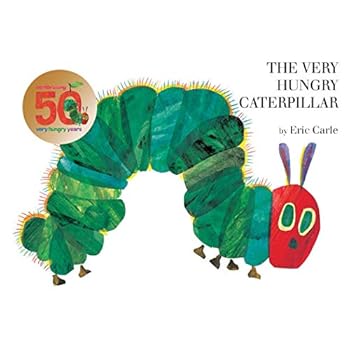
Description of The Very Hungry Caterpillar
Amazon.com Review 'In the light of the moon a little egg lay on a leaf.' So begins Eric Carle's modern classic, The Very Hungry Caterpillar. More than 12 million copies of this book have been sold in its original, full-sized edition, and the beloved tale of science and gluttony has been translated into 20 languages. This five-by-four-inch miniature edition is truly tiny, with tiny type, but it is a nice size for small hands to hold and flip through the pictures. Despite its diminished state, the book is complete in every detail, following the ravenous caterpillar's path as he eats his way through one apple (and the pages of the book itself) on Monday, two pears on Tuesday, three plums on Wednesday, and so on, through cherry pie and sausage--until he is really fat and has a stomachache. And no doubt you know what happens next! Kids love butterfly metamorphosis stories, and this popular favorite teaches counting and the days of the week, too. A fun gift package for caterpillar fans. (Baby to preschool) --Karin Snelson Eric Carle and Tomie dePaola: Author One-on-One Eric Carle is the creator, author, and illustrator of The Very Hungry Caterpillar and many other children�s books. Tomie dePaola is the author and illustrator of Strega Nona: Her Story and countless other books. They recently had a conversation about their careers as picture book authors. Tomie dePaola: When I was only four years old, I announced to my family in particular and to the world in general that I was going to become an artist, and write stories and draw pictures for books. I never swayed from that early declaration. I�ve always been curious to know, what inspired you to become a creator and illustrator of picture books? Eric Carle: My career began as a graphic designer and for a number of years I worked as an art director for an advertising agency in New York. In the mid 1960's Bill Martin, Jr. saw an ad of a red lobster that I had designed and asked me to illustrate his Brown Bear, Brown Bear, What Do You See? Well, I was set on fire! I was so inspired by this book, and the opportunity to illustrate it changed my life. After that, I started to create my own books, both words and pictures, and really it was then that I had found my true course in life. Now, I have a question for you, Tomie. How would you describe your artistic style, and has it changed over time? Tomie dePaola: My illustration style is heavily influenced by folk art--strong simple shapes, bold lines, color, color, color and a deceptive simplicity. My style began to develop early in art school, and through the years, it hasn�t changed very much, but it has refined itself. How would you describe yours? Eric Carle: My aim with my work is to simplify and refine, be logical and harmonious. I like to use simple shapes, bright colors and a lot of white space. I write for the child inside of me. That is always where I begin. Tomie dePaola: I do, as well. The only audience I keep in mind is that four-year-old in me. People sometimes ask me what advice I would give to young artists. I always think of the wonderful advice I received from my twin cousins when they were in art school in the late '30s. They told me, �Practice, practice, practice and don�t copy.� Eric Carle: I often tell people about the four magic letters: DO IT. I want to be encouraging but I can only offer the example of my own experience, which is just one approach. There are many wonderful artists to learn about, which is important. But you must use your own imagination. You have to just do it. Tomie dePaola: How do you feel knowing that a copy of The Very Hungry Caterpillar is sold every 30 seconds, somewhere in the world? Eric Carle: It is hard for me, maybe for others too, to grasp this concept. But I am truly honored that my story is enjoyed by so many and that it is now being shared by a generation of parents who grew up with my book. How about your Strega Nona. She is one of your most popular characters. Can you share how she came to be? Tomie dePaola: In the �70s when I was teaching at a college, we were required to attend faculty meetings. I always sat in the back with a yellow legal pad. Everyone thought I was taking notes. At one meeting a doodle appeared of a little lady with a big nose and a big chin. I named her Strega Nona, and the rest is history. Speaking of history, how will you be celebrating the third annual Very Hungry Caterpillar Day this year? Eric Carle: On The Very Hungry Caterpillar Day, March 20th, I will probably be at home with my wife, Bobbie (I am a bit of a hermit, actually). But I will be saying a little toast to the caterpillar for whom I have a special place in my heart. And speaking of holidays, isn�t your favorite holiday Christmas. Do you have a special Christmas memory? Tomie dePaola: Christmas is my favorite holiday. My favorite Christmas was the one when I received tons and tons of art supplies: everything from an easel to paints, pads and pads of paper, and �how to draw� books. A Look Inside The Very Hungry Caterpillar (Board Book) (Click on Images to Enlarge) Read more About the Author Eric Carle is acclaimed and beloved as the creator of brilliantly illustrated and innovatively designed picture books for very young children. His best-known work, The Very Hungry Caterpillar, has eaten its way into the hearts of literally millions of children all over the world and has been translated into more than 25 languages and sold over twelve million copies. Since the Caterpillar was published in 1969, Eric Carle has illustrated more than sixty books, many best sellers, most of which he also wrote.Born in Syracuse, New York, in 1929, Eric Carle moved with his parents to Germany when he was six years old; he was educated there, and graduated from the prestigious art school, the Akademie der bildenden Kunste, in Stuttgart. But his dream was always to return to America, the land of his happiest childhood memories. So, in 1952, with a fine portfolio in hand and forty dollars in his pocket, he arrived in New York. Soon he found a job as a graphic designer in the promotion department of The New York Times. Later, he was the art director of an advertising agency for many years.One day, respected educator and author, Bill Martin Jr, called to ask Carle to illustrate a story he had written. Martin's eye had been caught by a striking picture of a red lobster that Carle had created for an advertisement. Brown Bear, Brown Bear, What Do You See? was the result of their collaboration. It is still a favorite with children everywhere. This was the beginning of Eric Carle's true career. Soon Carle was writing his own stories, too. His first wholly original book was 1,2,3 to the Zoo, followed soon afterward by the celebrated classic, The Very Hungry Caterpillar.Eric Carle's art is distinctive and instantly recognizable. His art work is created in collage technique, using hand-painted papers, which he cuts and layers to form bright and cheerful images. Many of his books have an added dimension - die-cut pages, twinkling lights as in The Very Lonely Firefly, even the lifelike sound of a cricket's song as in The Very Quiet Cricket - giving them a playful quality: a toy that can be read, a book that can be touched. Children also enjoy working in collage and many send him pictures they have made themselves, inspired by his illustrations. He receives hundreds of letters each week from his young admirers. The secret of Eric Carle's books' appeal lies in his intuitive understanding of and respect for children, who sense in him instinctively someone who shares their most cherished thoughts and emotions.The themes of his stories are usually drawn from his extensive knowledge and love of nature - an interest shared by most small children. Besides being beautiful and entertaining, his books always offer the child the opportunity to learn something about the world around them. It is his concern for children, for their feelings and their inquisitiveness, for their creativity and their intellectual growth that, in addition to his beautiful artwork, makes the reading of his books such a stimulating and lasting experience.Carle says: 'With many of my books I attempt to bridge the gap between the home and school. To me home represents, or should represent; warmth, security, toys, holding hands, being held. School is a strange and new place for a child. Will it be a happy place? There are new people, a teacher, classmates - will they be friendly? I believe the passage from home to school is the second biggest trauma of childhood; the first is, of course, being born. Indeed, in both cases we leave a place of warmth and protection for one that is unknown. The unknown often brings fear with it. In my books I try to counteract this fear, to replace it with a positive message. I believe that children are naturally creative and eager to learn. I want to show them that learning is really both fascinating and fun.'�copyright � 2000 by Penguin Group (USA) Books for Young Readers. All rights reserved. Read more
Books are everywhere. Libraries big and small and bookstores are splattered all over college campuses and larger cities. They are all filled with one of the most important things of all time—books. Those who read books appreciate the multiple places to find books. Those who aren’t fans of books, don’t understand what could make readers want to obsess over books. There is a reason for their obsession, though. You hear it all the time: read every day.Reading is important because it develops our thoughts, gives us endless knowledge and lessons to read while keeping our minds active. Reading books to help us learn and understand and makes us smarter, not to mention the knowledge, vocabulary and thinking skills we develop.In the world today where information are abundant, reading books is one of the best ways to be informed. Though reading might seem like simple fun, it can be helping your body and mind without you even realising what is happening. What makes reading so important? It can be for these reasons and not just knowledge.For those who don’t enjoy it, you might change your mind after hearing about the benefits. Can something so easy and fun be so helpful in your life? Of course, it can! Reading can be a great benefit to you in many different ways—such as sharpening your mind, imagination, and writing skills. With so many advantages, it should be an everyday occurrence to read at least a little something.Books can hold and keep all kinds of information, stories, thoughts and feelings unlike anything else in this world. Can words, paragraphs, and fictional worlds be all that great for you and your health? It definitely can, and it is a timeless form of entertainment and information
Step-By Step To Download The Very Hungry Caterpillar
- Click The Button "DOWNLOAD" Or "READ ONLINE"
- Sign UP registration to access & UNLIMITED BOOKS
- DOWNLOAD as many books as you like (personal use)
- CANCEL the membership at ANY TIME if not satisfied
- Join Over 80.000 & Happy Readers.
OR

No comments :
Post a Comment