
(READ) Expecting Better: Why the Conventional Pregnancy Wisdom Is Wrong--and What You Really Need to Know
[R.E.A.D] Expecting Better: Why the Conventional Pregnancy Wisdom Is Wrong--and What You Really Need to Know Online eBook
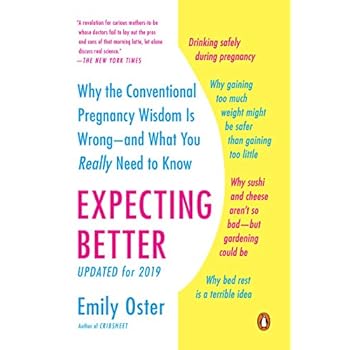
Description for Expecting Better: Why the Conventional Pregnancy Wisdom Is Wrong--and What You Really Need to Know
Review Praise for EXPECTING BETTER: � 'A revelation for curious mothers-to-be whose doctors fail to lay out the pros and cons of that morning latte, let alone discuss real science. And it makes for valuable homework before those harried ob-gyn appointments, even for lucky patients whose doctors are able to talk about the rationale behind their advice.'�New York Times � 'A book... that pregnant women won't want to miss.'�Parents Magazine�Emily Oster is the non-judgmental girlfriend holding our hand and guiding us through pregnancy and motherhood. She has done the work to get us the hard facts in a soft, understandable way.��Amy Schumer 'Oster's advice cuts through the emotion, myth, fear of malpractice litigation and looks at the numbers. A mother herself, Oster's interest isn't just curiosity, it's the same thing that motivates every new mom... and Oster's ability to break down the data into informed analysis is a refreshing break from the hysterical hearsay that often dominates the conversation.�Babyzone � 'Gives moms-to-be a big helping of peace of mind!'�Harvey Karp M.D., bestselling author of The Happiest Baby on the Block � 'It took someone as smart as Emily Oster to make it all this simple. She cuts through the thicket of anxiety and received wisdom, and gives us the facts. Expecting Better is both enlightening and calming. It almost makes me want to get pregnant.'�Pamela Druckerman, New York Times bestselling author of Bringing Up B�b� Read more About the Author Emily Oster is a professor of economics at Brown University and the author of Cribsheet:A Data-Driven Guide to Better, More Relaxed Parenting, from Birth to Preschool. She was a speaker at the 2007 TED conference and her work has been featured in The�New York Times, The Wall Street Journal, Forbes,and�Esquire. Oster is married to economist Jesse Shapiro and is also the daughter of two economists. She has two children. Read more Excerpt. � Reprinted by permission. All rights reserved. IntroductionIn the fall of 2009 my husband, Jesse, and I decided to have a baby. We were both economics professors at the University of Chicago. We�d been together since my junior year of college, and married almost five years. Jesse was close to getting tenure, and my work was going pretty well. My thirtieth birthday was around the corner.We�d always talked about having a family, and the discussion got steadily more serious. One morning in October we took a long run together and, finally, decided we were ready. Or, at the very least, we probably were not going to get any more ready. It took a bit of time, but about eighteen months later our daughter, Penelope, arrived.I�d always worried that being pregnant would affect my work�people tell all kinds of stories about �pregnancy brain,� and missing weeks (or months!) of work for morning sickness. As it happens, I was lucky and it didn�t seem to make much difference (actually having the baby was another story).But what I didn�t expect at all is how much I would put the tools of my job as an economist to use during my pregnancy. This may seem odd. Despite the occasional use of �Dr.� in front of my name, I am not, in fact, a real doctor, let alone an obstetrician. If you have a traditional view of economics, you�re probably thinking of Ben Bernanke making Fed policy, or the guys creating financial derivatives at Goldman Sachs. You would not go to Alan Greenspan for pregnancy advice.But here is the thing: the tools of economics turn out to be enormously useful in evaluating the quality of information in any situation. Economists� core decision-making principles are applicable everywhere. Everywhere. And that includes the womb.When I got pregnant, I pretty quickly learned that there is a lot of information out there about pregnancy, and a lot of recommendations. But neither the information nor the recommendations were all good. The information was of varying quality, and the recommendations were often contradictory and occasionally infuriating. In the end, in an effort to get to the good information�to really figure out the truth�and to make the right decisions, I tackled the problem as I would any other, with economics.At the University of Chicago I teach introductory microeconomics to first-year MBA students. My students would probably tell you the point of the class is to torture them with calculus. In fact, I have a slightly more lofty goal. I want to teach them decision making. Ultimately, this is what microeconomics is: decision science�a way to structure your thinking so you make good choices.I try to teach them that making good decisions�in business, and in life�requires two things. First, they need all the information about the decision�they need the right data. Second, they need to think about the right way to weigh the pluses and minuses of the decision (in class we call this costs and benefits) for them personally. The key is that even with the same data, this second part�this weighing of the pluses and minuses�may result in different decisions for different people. Individuals may value the same thing differently.For my students, the applications they care about most are business-related. They want to answer questions like, should I buy this company or not? I tell them to start with the numbers: How much money does this company make? How much do you expect it to make in the future? This is the data, the information part of the decision.Once they know that, they can weigh the pluses and minuses. Here is where they sometimes get tripped up. The plus of buying is, of course, the profits that they�ll make. The minus is that they have to give up the option to buy something else. Maybe a better company. In the end, the decision rests on evaluating these pluses and minuses for them personally. They have to figure out what else they could do with the money. Making this decision correctly requires thinking hard about the alternative, and that�s not going to be the same for everyone.Of course, most of us don�t spend a lot of time purchasing companies. (To be fair, I�m not sure this is always what my students use my class for, either�I recently got an e-mail from a student saying that what he learned from my class was that he should stop drinking his beer if he wasn�t enjoying it. This actually is a good application of the principle of sunk costs, if not the primary focus of class.) But the concept of good decision making goes far beyond business.In fact, once you internalize economic decision making, it comes up everywhere.When Jesse and I decided we should have a baby, I convinced him that we had to move out of our third-floor walk-up. Too many steps with a stroller, I declared. He agreed, as long as I was willing to do the house shopping.I got around to it sometime in February, in Chicago, and I trekked in the snow to fifteen or sixteen seemingly identical houses. When I finally found one that I liked (slightly) more than the others, the fun started. We had to make a decision about how much to offer for it.As I teach my students, we started with the data: we tried to figure out how much this particular house was worth in the market. This wasn�t too difficult. The house had last sold in 2007, and we found the price listed online. All we had to do was figure out how much prices had changed in the last two years. We were right in the middle of a housing crisis�hard to miss, especially for an economist�so we knew prices had gone down. But by how much?If we wanted to know about price changes in Chicago overall we could have used something called the Case-Shiller index, a common measure of housing prices. But this was for the whole city�not just for our neighborhood. Could we do better? I found an online housing resource (Zillow.com) that provided simple graphs showing the changes in housing prices by neighborhood in Chicago. All we had to do was take the old price, figure out the expected change, and come up with our new price.This was the data side of the decision. But we weren�t done. To make the right decision we still needed the pluses and minuses part. We needed to think about how much we liked this house relative to other houses. What we had figured out was the market price for the house�what we thought other people would want to pay, on average. But if we thought this house was really special, really perfect, and ideal for us in particular, we would probably want to bid more than we thought it was worth in the market�we�d be willing to pay something extra because our feelings about this house were so strong.There wasn�t any data to tell us about this second part of the decision; we just had to think about it. In the end, we thought that, for us, this house seemed pretty similar to all the other ones. We bid the price we thought was correct for the house, and we didn�t get it. (Maybe it was the pricing memo we sent with our bid? Hard to say.) In the end, we bought another house we liked just as much.But this was just our personal situation. A few months later one of our friends fell in love with one particular house. He thought this house was a one-of-a-kind option, perfect for him and his family. When it came down to it, he paid a bit more than the data might have suggested. It�s easy to see why that�s also the right decision, once you use the right decision process�the economist�s decision process.Ultimately, as I tell my students, this isn�t just one way to make decisions. It is the correct way.So, naturally, when I did get pregnant I thought this was how pregnancy decision making would work, too. Take something like amniocentesis. I thought my doctor would start by outlining a framework for making this decision�pluses and minuses. She�d tell me the plus of this test is you can get a lot of information about the baby; the minus is that there is a risk of miscarriage. She�d give me the data I needed. She�d tell me how much extra information I�d get, and she�d tell me the exact risk of miscarriage. She�d then sit back, Jesse and I would discuss it, and we�d come to a decision that worked for us.This is not what it was like at all.In reality, pregnancy medical care seemed to be one long list of rules. In fact, being pregnant was a lot like being a child again. There was always someone telling you what to do. It started right away. �You can have only two cups of coffee a day.� I wondered why�what were the minuses (I knew the pluses�I love coffee!)? What did the numbers say about how risky this was? This wasn�t discussed anywhere.And then we got to prenatal testing. �The guidelines say you should have an amniocentesis only if you are over thirty-five.� Why is that? Well, those are the rules. Surely that differs for different people? Nope, apparently not (at least according to my doctor).Pregnancy seemed to be treated as a one-size-fits-all affair. The way I was used to making decisions�thinking about my personal preferences, combined with the data�was barely used at all. This was frustrating enough. Making it worse, the recommendations I read in books or heard from friends often contradicted what I heard from my doctor.Pregnancy seemed to be a world of arbitrary rules. It was as if when we were shopping for houses, our realtor announced that people without kids do not like backyards, and therefore she would not be showing us any houses with backyards. Worse, it was as if when we told her that we actually do like backyards she said, �No, you don�t, this is the rule.� You�d fire your real estate agent on the spot if she did this. Yet this is how pregnancy often seemed to work.This wasn�t universal, of course; there were occasional decisions to which I was supposed to contribute. But even these seemed cursory. When it came time to think about the epidural, I decided not to have one. This wasn�t an especially common choice, and the doctor told me something like, �Okay, well, you�ll probably get one anyway.� I had the appearance of decision-making authority, but apparently not the reality.I don�t think this is limited to pregnancy�other interactions with the medical system often seem to be the same way. The recognition that patient preferences might differ, which might play an important role in deciding on treatment, is at least sometimes ignored. At some point I found myself reading Jerome Groopman and Pamela Hartzband�s book, Your Medical Mind: How to Decide What Is Right for You, and nodding along with many of their stories about people in other settings�prostate cancer, for example�who should have had a more active role in deciding which particular treatment was right for them.But, like most healthy young women, pregnancy was my first sustained interaction with the medical system. It was getting pretty frustrating. Adding to the stress of the rules was the fear of what might go wrong if I did not follow them. Of course, I had no way of knowing how nervous I should be.I wanted a doctor who was trained in decision making. In fact, this isn�t really done much in medical schools. Appropriately, medical school tends to focus much more on the mechanics of being a doctor. You�ll be glad for that, as I was, when someone actually has to get the baby out of you. But it doesn�t leave much time for decision theory.It became clear quickly that I�d have to come up with my own framework�to structure the decisions on my own. That didn�t seem so hard, at least in principle. But when it came to actually doing it, I simply couldn�t find an easy way to get the numbers�the data�to make these decisions.I thought my questions were fairly simple. Consider alcohol. I figured out the way to think about the decision�there might be some decrease in child IQ from drinking in pregnancy (the minus), but I�d enjoy a glass of wine occasionally (the plus). The truth was that the plus here is small, and if there was any demonstrated impact of occasional drinking on IQ, I�d abstain. But I did need the number: would having an occasional glass of wine impact my child�s IQ at all? If not, there was no reason not to have one.Or in prenatal testing. The minus seemed to be the risk of miscarriage. The plus was information about the health of my baby. But what was the actual miscarriage risk? And how much information did these tests really provide relative to other, less risky, options?The numbers were not forthcoming. I asked my doctor about drinking. She said that one or two drinks a week was �probably fine.� �Probably fine� is not a number. The books were the same way. They didn�t always say the same thing, or agree with my doctor, but they tended to provide vague reassurances (�prenatal testing is very safe�) or blanket bans (�no amount of alcohol has been proven safe�). Again, not numbers.I tried going a little closer to the source, reading the official recommendation from the American Congress of Obstetricians and Gynecologists. Interestingly, these recommendations were often different from what my doctor said�they seemed to be evolving faster with the current medical literature than actual practice was. But they still didn�t provide numbers.To get to the data, I had to get into the papers that the recommendations were based on. In some cases, this wasn�t too hard. When it came time to think about whether or not to get an epidural, I was able to use data from randomized trials�the gold standard evidence in science�to figure out the risks and benefits.In other cases, it was a lot more complicated. And several times�with alcohol and coffee, certainly, but also things like weight gain�I came to disagree somewhat with the official recommendations. This is where another part of my training as an economist came in: I knew enough to read the data correctly.A few years ago, my husband wrote a paper on the impact of television on children�s test scores. The American Academy of Pediatrics says there should be no television for children under two years of age. They base this recommendation on evidence provided by public health researchers (the same kinds of people who provide evidence about behavior during pregnancy). Those researchers have shown time and again that children who watch a lot of TV before the age of two tend to perform worse in school.This research is constantly being written up in places like the New York Times Science section under headlines like SPONGEBOB THREAT TO CHILDREN, RESEARCHERS ARGUE. But Jesse was skeptical, and you should be, too. It is not so easy to isolate a simple cause-and-effect relationship in a case like this.Imagine that I told you there are two families. In one family the one-year-old watches four hours of television per day, and in the other the one-year-old watches none. Now I want you to tell me whether you think these families are similar. You probably don�t think so, and you�d be right.On average, the kinds of parents who forbid television tend to have more education, be older, read more books, and on and on. So is it really the television that matters? Or is it all these other differences?This is the difference between correlation and causation. Television and test scores are correlated, there is no question. This means that when you see a child who watches a lot of TV, on average you expect him to have lower test scores. But that is not causation.The claim that SpongeBob makes your child dumber is a causal claim. If you do X, Y will happen. To prove that, you�d have to show that if you forced the children in the no-TV households to watch SpongeBob and changed nothing else about their lives, they would do worse in school. But that is awfully hard to conclude based on comparing kids who watch TV to those who do not.In the end, Jesse (and his coauthor, Matt) designed a clever experiment.1 They noted that when television was first getting popular in the 1940s and 1950s, it arrived in some parts of the country earlier than others. They identified children who lived in areas where TV was available before they were two, and compared them to children who were otherwise similar but lived in areas with no TV access until they were older than two. The families of these children were similar; the only difference was that one child had access to TV early in life and one did not. This is how you draw causal conclusions.And they found that, in fact, television has no impact on children�s test scores. Zero. Zilch. It�s very precise, which is a statistical way of saying they are actually quite sure that it doesn�t matter. All that research in public health about the dangers of SpongeBob? Wrong. It seems very likely that the reason SpongeBob gets a bad rap is that the kinds of parents who let their kids watch a lot of television are different. Correlation, yes. Causation, no.Just to be clear, I�m still a little wary of television, being from one of those families where we could never watch TV. Jesse is not. Occasionally, when he thinks I�m not looking, I catch him and Penelope in the basement snuggling on the couch, enjoying some Sesame Street. When I protest, he points to the evidence, and I can�t really argue.Pregnancy, like SpongeBob, suffers from a lot of misinformation. One or two weak studies can rapidly become conventional wisdom. At some point I came across a well-cited study that indicated that light drinking in pregnancy�perhaps a drink a day�causes aggressive behavior in children. The study wasn�t randomized; they just compared women who drank to women who did not. When I looked a little closer, I found that the woman who drank were also much, much more likely to use cocaine.We know that cocaine is bad for your child�not to mention the fact that women who do cocaine often have other issues. So can we really conclude from this that light drinking is a problem? Isn�t it more likely (or at least equally likely) that the cocaine is the problem?Some studies were better than others. And often, when I located the �good� studies, the reliable ones, the ones without the cocaine users, I found them painting a pretty different picture from the official recommendations.These recommendations increasingly seemed designed to drive pregnant women crazy, to make us worry about every tiny thing, to obsess about every mouthful of food, every pound we gained. Actually getting the numbers led me to a more relaxed place�a glass of wine every now and then, plenty of coffee, exercise if you want, or not. Economics may not be known as a great stress reliever, but in this case it really is.More than even the actual recommendations, I found having numbers at all provided some reassurance. At some point I wondered about the risks of the baby arriving prematurely. I went to the data and got some idea of the chance of birth in each pregnancy week (and the fetal survival rate). There wasn�t any decision to be made�nothing to really do about this�but just knowing the numbers let me relax a bit. These were the pregnancy numbers I thought I�d get from my doctor and from pregnancy books. In the end, it just turned out that I had to get them myself.I�ve always been someone for whom knowing the data, knowing the evidence, is exactly what I need to chill out. It makes me feel comfortable and confident that I�m making the right choices. Approaching pregnancy in this way worked for me. I wasn�t sure it would work for other people.And then my friends got pregnant. Pretty much all of them at the same time. They all had the same questions and frustrations I had. Can I take a sleeping pill? Can I have an Italian sub (I really want one! Does that make a difference?)? My doctor wants to schedule a labor induction�should I do it? What�s the deal with cord-blood banking?Sometimes they weren�t even pregnant yet. I had lunch with a friend who wanted to know whether she should worry about waiting a year to try to get pregnant�how fast does fertility really fall with age?Their doctors, like mine, had a recommendation. Sometimes there was an official rule. But they wanted to make the decision that was right for them. I found myself referring to my obstetrics textbook, and to the medical literature, long after my Penelope was born. There was a limit to the role I could play�no delivering babies, fortunately (for me and, especially, the babies). But I could provide people with information, give them a way to discuss concerns with their OBs on more equal footing, help them make decisions they were happy with.And as I talked to more and more women it became clear that the information I could give them was useful precisely because it didn�t come with a specific recommendation. The key to good decision making is taking the information, the data, and combining it with your own estimates of pluses and minuses.In some cases, the existing rule is wrong. In others, it isn�t a question of right or wrong but what is right for you and your pregnancy. I looked at the evidence on the epidural, combined it with my own plus and minus preferences, and decided not to have one. My friend Jane looked at the same evidence and decided to have one. In the end, I felt fine eating deli meats; my college roommate Tricia looked at the evidence and decided she would avoid them. All of these are good decisions.So this book is for my friends. It�s the pregnancy numbers�the data to help them make their personalized pregnancy decisions and to help them understand their pregnancies in the clearest possible way, by the numbers. It�s the suggestion that maybe it�s okay to have a glass of wine and, more important, the data on why. It�s the numbers on the risk of miscarriage by week, data on which fish to eat to make your kid smart (and which to avoid because they could make your kid dumb), information on weight gain, on prenatal testing versus prenatal screening, on bed rest and labor induction, on the epidural and the benefits (or not) of a birth plan. This book is a way to take control and to expect better.Pregnancy and childbirth (and child rearing) are among the most important and meaningful experiences most of us will ever have; probably the most important. Yet we are often not given the opportunity to think critically about the decisions we make. Instead, we are expected to follow a largely arbitrary script without question. It�s time to take control: pick up a cup of coffee or, if you like, a glass of wine, and read on.PART 1In the Beginning: Conception���������1���������Prep WorkSome pregnancies are a surprise. If you�re one of those women who woke up feeling queasy, took a pregnancy test on a whim, and were shocked to see the second pink line show up, congratulations! Please skip ahead.But for a lot of us, we�re thinking about getting pregnant long before it actually happens. I met my husband in college in 2001. We got married in 2006. Our daughter was born in 2011. I won�t say I spent the whole ten years thinking about a baby, but I (and, later, we) did make a lot of choices with at least the long-term plan of having a family.And as I approached 30, and pregnant friends started popping up here and there, I thought a little more seriously. I wondered if there was something I should be doing in advance, even before we started trying to get pregnant. Should I change my diet? My doctor did once suggest I should cut down on coffee, just so it wouldn�t be such a shock to reduce when I was pregnant. Was that really necessary?Mostly, I worried that I was getting old.Thirty is not actually old in pregnancy terms. �Advanced maternal age� is reserved for women over 35, and you wouldn�t be faulted for thinking that 35 was a sharp cutoff. I read one paper once that referred to eggs as �best used by 35.� Thanks, it�s really helpful to know my sell-by date. But, of course, 35 is not a magical number. Biological processes don�t work like this. Your eggs don�t wake up on the morning of your 35th birthday and start planning their retirement party.Starting pretty much the first day you menstruate, your fertility is declining. Your most fertile time is in your teens, and it goes down from there�30 is worse than 20, and 40 is worse than 30. But, of course, there are other factors that push you in other directions. I certainly wasn�t in a good position to have a baby in my first year of graduate school at 23, and the truth is that I�d probably be in a better position at 35 than at 30.It wasn�t the only consideration, but I did wonder about how fast fertility declined. My doctor didn�t seem worried��You�re not thirty-five yet!� she said�but that wasn�t quite the detailed reassurance I was looking for.I went looking for reassurance (or, at least, information) in the world of data, in the academic medical literature. As I expected, there was an answer. It just wasn�t quite what the over-35 retired-eggs story would have suggested.The main research on this uses data from the 1800s (it�s old but the technology hasn�t changed much!). Here is the idea: prior to the modern era, couples would pretty much get down to business right after the wedding, and there were limited birth control options. So you can figure out how fertility varies with age by looking at the chance of having children at all for women getting married at different ages.Researchers found that the chance of having any children was very similar for women who got married at any age between 20 and 35. Then it began to decline: women who got married between 35 and 39 were about 90 percent as likely to have a child as those who got married younger than 35; women who got married between 40 and 44 were only about 62 percent as likely; and women who got married between 45 and 49 were only 14 percent as likely. Put differently, virtually everyone who got married between 20 and 35 had at least one child, compared to only about 14 percent of those who got married after 45.You may or may not like to draw conclusions from such old data. People live longer now, and are healthier longer. It is certainly possible that as longevity and health increase, women will remain fertile longer. Even if you do take this data at face value, the reduction in fertility is not as dramatic as you might have feared. The 35- to 39-year-old group is only slightly less likely to have children; the major drop in fertility is not until after 40, and at least some women over 45 in this data did conceive�this in an era well before in vitro fertilization (IVF)!Contemporary data looks fairly similar, perhaps even somewhat more encouraging. Researchers in France studied a group of around 2,000 women who were undergoing insemination with donor sperm. One nice aspect of this study is that they didn�t have to worry that older people had sex less frequently because everyone in the study was trying to get knocked up at the right time of the month in a controlled environment. After 12 cycles, the pregnancy rate was around 75 percent for women under 30, 62 percent for women 31 to 35, and 54 percent for women over 35. In this oldest group things were similar for women 36 to 40 and over 40. More than half of the over-40 women in the sample got pregnant within a year.1In the end, my doctor was basically right to pooh-pooh my worries. But for me, seeing the numbers this way, in black and white, was far more reassuring. I could see in detail that starting to try at 30 rather than at 28 was not going to make that much difference. I could think about the timing if we wanted, for example, more than one child. And I could see that the numbers were all pretty high�for me, reading �75 percent of women were pregnant with a year� was a lot more helpful than hearing things like, �It works out for most women.� For one thing, how do I know if your �most� is the same as mine?I�d experience this again and again. The value of having numbers�data�is that they aren�t subject to someone else�s interpretation. They are just the numbers. You can decide what they mean for you. In this case, it�s true that it�s harder to get pregnant when you are older. But it�s not impossible, not even close.When we did start thinking more seriously about a baby, I stopped focusing so much on age. (After all, what could I do? Not getting older is not exactly an option.) But I did wonder about other things I might do to prepare. I asked my OB at my yearly visit if there was anything I should be aware of. Other than some generic advice to relax (not one of my strengths), the one thing she focused on was exercise. Make sure you are exercising before you get pregnant.When I talked to other women, it seemed like this was part of a more general theme�it�s a good idea to try to be in good physical shape before getting pregnant. Independent of any medical advice, I had long harbored the fantasy of getting to my �goal weight� prior to pregnancy. I had achieved this weight exactly once in my life, before my wedding, through a process of five A.M. ninety-minute cardio workouts four days a week. I figured if I got to this weight again before we got pregnant, I�d be one of those Heidi Klum�type women who look great through the whole pregnancy and are back to bikini modeling eight weeks after giving birth.In the end, of course, I got pregnant right after our summer vacation, not exactly the most weight-loss-friendly time of year. That�s okay, I figured, I�m sure it will be easy to get to that goal weight after the baby is born. I am nothing if not optimistic.Other than some feeling of personal achievement, it wasn�t clear to me why I should care about my prepregnancy weight. Does it matter for anything? A few pounds here and there, obviously not. Overall, yes. Women (and their doctors) worry a lot about weight gain during pregnancy, but it turns out that weight before pregnancy is much more important.About 70 percent of the U.S. population are overweight (defined as a body mass index over 25), and 35 percent are obese (BMI over 30). (Note: to calculate your BMI, take your weight in kilograms and divide it by your height in meters squared. If you are 5 feet 6 inches and 150 pounds, your BMI is 24.2.) On a number of important dimensions, obese women in particular have more difficult pregnancies than normal-weight women.One study that demonstrates this effectively used a group of roughly 5,000 births at one hospital in Mississippi.2 The advantage of using a single hospital is that it means the women are all pretty similar in terms of income, education, and other characteristics. A large percentage of the women in the study were obese.The authors looked at a very large number of outcomes related to the mothers: preeclampsia, urinary tract infection, gestational diabetes, preterm delivery, the need for labor induction, Cesarean delivery, and postpartum hemorrhage (bleeding after birth). Th
Books are everywhere. Libraries big and small and bookstores are splattered all over college campuses and larger cities. They are all filled with one of the most important things of all time—books. Those who read books appreciate the multiple places to find books. Those who aren’t fans of books, don’t understand what could make readers want to obsess over books. There is a reason for their obsession, though. You hear it all the time: read every day.Reading is important because it develops our thoughts, gives us endless knowledge and lessons to read while keeping our minds active. Reading books to help us learn and understand and makes us smarter, not to mention the knowledge, vocabulary and thinking skills we develop.In the world today where information are abundant, reading books is one of the best ways to be informed. Though reading might seem like simple fun, it can be helping your body and mind without you even realising what is happening. What makes reading so important? It can be for these reasons and not just knowledge.For those who don’t enjoy it, you might change your mind after hearing about the benefits. Can something so easy and fun be so helpful in your life? Of course, it can! Reading can be a great benefit to you in many different ways—such as sharpening your mind, imagination, and writing skills. With so many advantages, it should be an everyday occurrence to read at least a little something.Books can hold and keep all kinds of information, stories, thoughts and feelings unlike anything else in this world. Can words, paragraphs, and fictional worlds be all that great for you and your health? It definitely can, and it is a timeless form of entertainment and information
Step-By Step To Download Expecting Better: Why the Conventional Pregnancy Wisdom Is Wrong--and What You Really Need to Know
- Click The Button "DOWNLOAD" Or "READ ONLINE"
- Sign UP registration to access & UNLIMITED BOOKS
- DOWNLOAD as many books as you like (personal use)
- CANCEL the membership at ANY TIME if not satisfied
- Join Over 80.000 & Happy Readers.
OR

No comments :
Post a Comment