
Read Online The Pioneers: The Heroic Story of the Settlers Who Brought the American Ideal West
PDF READ FREE The Pioneers: The Heroic Story of the Settlers Who Brought the American Ideal West [PDF Ebook]
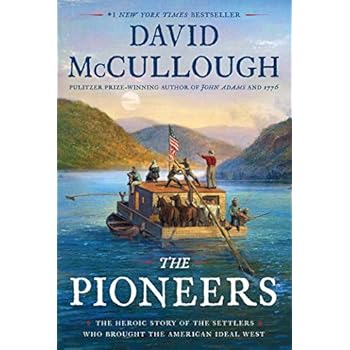
Description for The Pioneers: The Heroic Story of the Settlers Who Brought the American Ideal West
Review 'A tale of uplift, with the antislavery settlers embodying a vision of all that was best about American values and American ideals.', The New York Times Book Review Editor's Choice�David McCullough has become perhaps our best-loved chronicler of America�s past. . . . The Pioneers is the account not just of one Ohio settlement but of myriad such places across America, where innumerable immigrants (as the settlers were known) came to make a fresh start in a strange land. It is a story as resonant today as ever.� -- Gerard Helferich, The Wall Street Journal�McCullough is among the most thoughtful and thorough historians of the past two generations. . . . [A] great American mind.� -- John S. Gardner, The Guardian'McCullough is a master of research along with being a wonderful storyteller. He takes the history of the area and turns what could be dry and dull into vibrant and compelling tales. . . .�Lovers of history told well know that McCullough is one of the best writers of our past, and his latest will only add to his acclaim.' -- Jeff Ayers, Associated Press'To read The Pioneers�is to understand that the settlement of the Northwest Territory was, in some ways, a second phase of the American Revolution � a messy experiment, touched by high ideals and bitter conflicts, that still resonates in ways we�re only beginning to grasp.' � -- Danny Heitman, Christian Science Monitor�Like McCullough's other books,�The Pioneers�succeeds because of the author's strength as a storyteller. The book reads like a novel, with a cast of fascinating characters that the average reader isn't likely to know about. . . . A�worthy addition to McCullough's impressive body of work.� -- Michael Schaub, NPR.org'Readers will immediately recognize that storytelling is one of Mr. McCullough�s great literary strengths. He consistently produces engaging prose about a particular period of time, and makes history come alive.' � -- Michael Taube, The Washington Times'A lively history of the Ohio River region in the years between the Revolution and the Civil War. . . . [McCullough's]�narrative abounds with well-recognized figures in American history�John Quincy Adams, Harriet Beecher Stowe, Johnny Appleseed�while highlighting lesser-known players. . . . Vintage McCullough and a book that students of American history will find captivating.', Kirkus Reviews (starred review)�In his usual revealing style, McCullough has crafted another dynamic volume of American history. With clarity and incisiveness, he details the experience of a brave and broad-minded band of people who crossed raging rivers, chopped down forests, plowed miles of land, suffered incalculable hardships and braved a lonely frontier to forge a new American ideal. They were indeed the pioneers.' � -- Dave Kindy, The Providence Journal Read more About the Author David McCullough has twice received the Pulitzer Prize, for Truman and John Adams, and twice received the National Book Award, for The Path Between the Seas and Mornings on Horseback. His other acclaimed books include The Johnstown Flood, The Great Bridge, Brave Companions, 1776, The Greater Journey,�The American Spirit,�and The Wright Brothers. He is the recipient of numerous honors and awards, including the Presidential Medal of Freedom, the nation�s highest civilian award. Visit DavidMcCullough.com. Read more Excerpt. � Reprinted by permission. All rights reserved. The Pioneers CHAPTER ONE The Ohio Country The Ohio is the grand artery of that portion of America which lies beyond the mountains. . . . I consider therefore the settlement of the country watered by this great river as one of the greatest enterprises ever presented to man. �J. HECTOR ST. JOHN DE CR�VECOEUR, 1782 I. Never before, as he knew, had any of his countrymen set off to accomplish anything like what he had agreed to undertake�a mission that, should he succeed, could change the course of history in innumerable ways and to the long-lasting benefit of countless Americans. That he had had no prior experience in such a venture and was heading off alone in his own one-horse shay appears to have been of little concern. If he was as yet unknown to those with whom he would be dealing, he carried with him letters of introduction from the governor of Massachusetts, the president of Harvard College, and some forty others. The day of his departure was Sunday, June 24, 1787. Manasseh Cutler was forty-five years old and pastor of the First Congregational Church of Ipswich Hamlet, a tiny Massachusetts village not far from the sea, thirty miles north of Boston. He had been born and raised on a hilltop farm in Killingly, Connecticut, and given the biblical name of Manasseh after the oldest son of Joseph. Like most New Englanders, he was a descendant of those strong-minded English Puritans who had landed in America in the seventeenth century and proliferated ever since. James Cutler, the first of the family to arrive, had fathered twelve children. The Reverend Cutler himself was one of five and the father of eight. He had attended Yale College, with classmates mainly from New England among whom a biblical name such as he had was by no means uncommon. He was distinguished for �diligence and proficiency,� and finished with honors in 1765. In less than a year he married Mary Balch of Dedham, Massachusetts, a small trim blonde said to have had a no less amiable disposition than he. Her father, the Reverend Thomas Balch, performed the wedding ceremony. When offered the chance to run a chandlery�a ship supply store�in Edgartown on the island of Martha�s Vineyard, bride and groom moved immediately to the island and there remained for three years, time enough for two sons, Ephraim and Jervis, to be born, and for Manasseh to conclude that a mercantile life was not for him. He resolved to enter the ministry under the tutelage of his father-in-law back in Dedham. His studies continued for nearly two years, during which he started preaching in one town or another. �Prosecuted my study,� he wrote in his diary. �Began to make sermons. May God grant me his blessing and assistance in so important an undertaking, and make me serviceable to the cause of religion, and the souls of my fellow men.� He was offered the pulpit at Ipswich Hamlet. The day of his ordination, at age twenty-nine, the Meeting House was thronged so �exceedingly� that not more than half the people were able to attend. A bit above average in height, stout but well-proportioned, the Reverend Cutler had a ruddy, healthy look, and dressed always in ministerial black�black velvet coat and breeches, black silk stockings. He would be described as a gentleman of �the old style, country type.� But stiff-necked and somber he was not, any more than were most Puritans, contrary to latter-day misconceptions. Puritans were as capable as any mortals of exuding an affable enjoyment of life, as was he. Like many a Puritan he loved good food, good wine, a good story, and good cheer. His black clerical attire, a professional requirement, by no means represented disapproval of bright colors in clothing or furniture or decoration. It was said he could out-talk anyone, and from numerous of his diary entries, it is obvious, too, that he had an eye for attractive women. But here again that was no violation of Puritan rules. He had as well great love for his large family, his wife and children, and was ever attentive to their needs for as long as he lived. In addition to all this, and importantly, Manasseh Cutler was endowed with boundless intellectual curiosity. It may be said he was a university unto himself, ranking high among the notable polymaths of the time, those �of great and varied excellence� who took an interest in nearly everything. He had succeeded in becoming three doctors in one, having qualified for both a doctor of law and doctor of medicine, in addition to doctor of divinity, and having, from time to time, practiced both law and medicine. At one point he looked after some forty smallpox patients and seems to have gained a local reputation for his particular skill at coping with rattlesnake poisoning. He became an honorary member of the Massachusetts Medical Society, received a degree of Master of the Arts from Harvard, and was elected a member of the Academy of Arts and Sciences. Further, to supplement his meager income as pastor�never more than $450 a year�he had added a third floor to the rectory and established his own private boarding school where the students were �prepared for usefulness in the world.� Most remarkable were his continuing scientific pursuits. He was at once an avid astronomer, meteorologist, and naturalist. Over the years, his modest income notwithstanding, he had acquired his own barometer, thermometer, telescope, spyglasses, and celestial globe, and was particularly esteemed among fellow scientists for his work in botany, and for having written the first-ever treatise on the classification of the flora of New England�a study of some 350 separate species. His knowledge of botany was probably surpassed by few if any Americans of his generation. Year after year he carried on extensive correspondence with leading figures in all the sciences on both sides of the Atlantic. One letter concerning his studies of the aurora borealis, written in 1778 to Ezra Stiles, the president of Yale, went on for twenty-four pages. Between times he studied French. Indeed, he seems to have been studying something nearly every waking hour. �Engaged in the study of botany,� reads one diary entry. �This morning endeavored to observe the eclipse of the moon,� reads another. �Studied,� �studied hard,� �studied very hard,� he recorded one day after another. Once, with a half dozen others, he climbed the highest peak in the White Mountains of New Hampshire, carrying a heavy barometer on his back in the spirit of wanting to bring back new knowledge�to compute the elevation at the summit, which he recorded to be 9,000 feet. That either he or the barometer had overestimated the height by some 2,600 feet did not in the least deter his zest for learning. On the day of his departure on his unprecedented new mission, he brought with him the cabinet necessary for saving botanical specimens collected along the way. He had a favorite quotation from Virgil that to his family seemed the key to his character, �Felix, qui potuit rerum cognoscere causas���Fortunate is he who understands the cause of things.� The year before, on the morning of March 1, 1786, the Reverend Cutler and ten others gathered in Boston at the famous Bunch of Grapes tavern, at the corner of King and Kilby Streets. Their purpose was to launch a highly ambitious plan involving the immense reach of unsettled wilderness known as the Northwest Territory. They were a group of veteran officers in the Continental Army, as Cutler was considered also, having served six months during the Revolutionary War as an army chaplain. At the peace treaty ending the war, signed in Paris in 1783, the American diplomats John Adams and John Jay had insisted that all the lands controlled by the British west of the Allegheny Mountains and northwest of the Ohio River east of the Mississippi, be ceded to the new United States. The British commissioners persistently urged making the Ohio River the westernmost boundary of the United States, but John Adams, it is said, responded indignantly, �No! Rather than relinquish our claim to the western territory, I will go home and urge my countrymen to take up arms again and fight till they secure their rights, or shed the last drop of blood.� John Jay agreed and the British found it best to yield the point. The land on the southern side of the Ohio was part of Virginia and already being rapidly settled according to the Virginia system, which allowed a man to take and mark for himself any unappropriated lands. By the New England system, so-called, the land lying north of the river was to be properly surveyed and sold, the establishment of settlements done by legal process, and lands of the natives to remain theirs until purchased from them. Until that point the United States government did not own a single acre of land. Now, all at once, almost unimaginably, it had acquired some 265,878 square miles of unbroken wilderness, thus doubling the size of the United States. It was an unsettled empire north and west of the Ohio River, bigger than all of France, with room enough for as many as five more states and included access to four of the five Great Lakes, one of which, Lake Michigan, reached to its very center. And then there was the Ohio River, itself a great natural highway west, la Belle Rivi�re, as the early French explorer Ren�-Robert Cavelier de La Salle had called it. The new realm was spoken of as �the back country,� �the vast interior,� �the howling wilderness,� �the fair domain beyond the Ohio,� or simply �the Ohio country.� There were no roads as yet anywhere in all this wilderness, no bridges, no towns, churches, schools, stores, or wayside taverns. In New England there were more than a thousand towns, one about every five miles. But in all the immense territory to the northwest of the Ohio River, the territory from which five states were to emerge�Ohio, Indiana, Illinois, Michigan, and Wisconsin�there was as yet not one permanent legal settlement. A few remote forts had been established and there were hunters, trappers, fur traders, and �squatters,� those who settled wherever they chose and without legal claim to the land. Much, too, was reported of forests teeming with wolves, bears, wild boars, panthers, rattlesnakes, and the even more deadly copperheads. And, as every easterner knew, there was the �Indian menace,� the many native tribes who considered the Ohio country their rightful, God-granted domain. Much blood had already been shed in wilderness battles and atrocities committed by both natives and white men. These were realities well-known throughout the east and particularly on the minds of those gathered at the Bunch of Grapes. Worst of all had been the infamous massacre by American militia of ninety-six peaceable Delaware Indians in central Ohio in 1782�Christian men, women, and children who knelt singing hymns as they were systematically clubbed to death, all because they were mistakenly thought to have had a part in the murder of a family of settlers. In revenge soon after, at Upper Sandusky, the Delawares stripped naked, tortured, cut off the ears, burned while still alive, and scalped a captured American officer, a friend of George Washington�s, Colonel William Crawford. Delaware justice demanded a life for a life be taken, but they would give an enemy an opportunity to die well and honor his family during ritual torture. Crawford�s dismemberment was also to insure that he would be a less formidable enemy in the next world. The story of Crawford�s fate, the ultimate frontier nightmare, was told over and over back east. Only the year before the Bunch of Grapes meeting, one of the group, General Benjamin Tupper, as part of a government surveying party, had been turned back from entering the Ohio country so severe was Indian resistance to the encroaching settlers. Then, too, there was also the immediate reality of serious, mounting troubles right at home. Unprecedented financial panic had gripped the new nation since the end of the Revolutionary War. The resources and credit of the government were exhausted. Money, in the form of scrip issued by the government, was nearly worthless. The scrip the veterans received as compensation for their service was worth no more than ten cents on the dollar. Trade was at a standstill. In Massachusetts the situation was worst of all. Farmers were being imprisoned for debt. Only a few months earlier an armed rebellion led by a poor Massachusetts farmer and war veteran named Daniel Shays had to be put down by a force of loyal militia commanded by General Tupper. As it was, the severe economic depression that followed the war would last longer even than the war. But out west now there was land to be had as never imagined�vast land, rich land where there was �no end to the beauty and plenty��that could be made available to veterans at a bargain price in compensation for their service. West was opportunity. West was the future. �As time progressed, the New England Revolutionary officers and soldiers interested in western immigration became more and more impatient to realize their hopes,� as one settler was to write. They were poorer than their neighbors who had not been in the field; and if they had more of pride, that was only natural from the lives they had led, and surely they had a right to feel proud of the services they had rendered. One who was among them, and a close observer, says that they had a better and more dignified bearing than before the war, dressed more handsomely, and were improved in manners and conversation. . . . These men it must be remembered did not receive money in pay for their fatigue, exposure and suffering, but final certificates in settlement. �The spirit of immigration never ran higher with us than at this time,� Manasseh Cutler wrote to a member of the Congress, Nathan Dane, who happened also to be a Massachusetts neighbor. The leading figure�the driving force�at the Bunch of Grapes gathering was a widely known hero of the Revolution and, in normal times, a farmer and surveyor, General Rufus Putnam. It was he who had called the meeting. A commanding presence, he stood nearly six feet tall and spoke in a manner described as straightforward and impressive. One of his eyes had been disfigured by a childhood injury that �gave it an outward, oblique cast, leaving the expression of his face strongly impressed on the mind of the beholder.� In his portrait he is shown in profile, with the intention, no doubt, to hide the bad eye. As would be said: He was not brilliant, he was not quick, but he was richly endowed with that best of gifts�good, sound, common sense, and he had, in unusual degree, that prescience that enabled him to skillfully adapt means to ends, so as thereby to accomplish what he wished. . . . His judgment was sound, he was patient and had great power of endurance. His integrity was never questioned. He was also known to be full of jokes and loved to sing. Most important to matters at hand, Rufus Putnam, before the end of the Revolution, had led 288 officers in signing what was known as the Newburgh Petition, whereby land bounties promised to veterans would be provided in the Ohio country in payment for their military services. Then, at the war�s end, he had written a long letter to Washington about the possibilities represented by the Ohio country, knowing Washington as a young man had seen that wilderness firsthand on surveying expeditions and, further, that Washington owned land there. He was already an Ohio land speculator. I am, sir [Putnam wrote], among those who consider the cession of so great a tract of territory to the United States . . . a very happy circumstance and of great consequence to the American empire. Washington, though a Virginian to the core, had particularly high regard for the New Englanders who had served under his command. A great part of his military history had been made north of the Potomac, beginning in Boston. Many there were in New England, Putnam assured him, waiting for the chance to head west as settlers, and there was �not the least doubt but other valuable citizens will follow their example.� In a letter to Congress, Washington strongly supported the idea, but in a subsequent letter to Putnam he wrote, �. . . matters, as far as they have come to my knowledge, remain in statu quo.� In 1784 Putnam wrote again to Washington to assure him settlement of the Ohio country still �engrosses many of my thoughts, and much of my time,� and that as soon as Congress made provisions for granting land there, thousands from New England would emigrate. Meanwhile, however, many were �growing quite impatient, and the general inquiry now is, when are we going to the Ohio?� It was being called �Ohio Fever.� Putnam preferred to call it �the Ohio cause.� In 1784 an ordinance for the government of the Northwest Territory had been drawn up by several members of Congress including Thomas Jefferson. It proposed, �That after the year 1800 . . . there shall be neither slavery nor involuntary servitude in any of the said States. . . .� The ordinance passed but without any slavery restrictions, and without them as would be said, it was �a dead letter.� Jefferson had since backed off from his position on slavery, having decided not to risk his political �usefulness� by maintaining such a stand. Further, by this time he had resigned his seat in Congress and departed for France to serve as the new American ambassador. The plan set forth now at the Bunch of Grapes was to form an association or company to purchase from the government lands in Ohio and establish a first settlement there. A �very pleasing description� of the western country was provided by both Generals Putnam and Tupper. Manasseh Cutler, too, took an active part in the discussions. He had read nearly all that had been published of the writings of early French explorers and like others had been moved especially by descriptions of the land and the river by St. John de Cr�vecoeur. It is, without doubt, the most fertile country, with the most varied soil, the best watered, and that which offers to agriculture and commerce, the most abundant and easy resources, of all those which the Europeans have ever discovered. . . . Cr�vecoeur also described the experience of giving oneself up to the current of the Ohio River. �This sweet and tranquil navigation appeared to me like an agreeable dream.� (In a book he was soon to publish, Notes on the State of Virginia, Thomas Jefferson referred to the Ohio as �the most beautiful river on earth,� though, like Manasseh Cutler, he had never seen it.) Full agreement at the Bunch of Grapes gathering was reached with no difficulty and in the days that followed further details were seen to. It was to be called the Ohio Company of Associates and Rufus Putnam was to be its chairman. A fund of a million dollars would be raised. No one could purchase less than one share, or more than five. Payment for each share would be primarily the face value of the certificates held by the veterans, plus $10 in gold or silver. The cash raised by the $10 payments was to cover the company�s operating expenses. That the Ohio Company was also, apart from its noble intentions, a venture in land speculation went without saying. Those founders taking part at the Bunch of Grapes were to receive generous compensation. Rufus Putnam and Manasseh Cutler, for example, were each to receive four shares, or 4,692 acres of land. Major Winthrop Sargent, another surveyor who had been to Ohio, was named secretary of the company, and Manasseh Cutler was chosen to negotiate with the Continental Congress in the purchase of the land. He was also to have a say in the enactment of a new Ordinance, whereby Congress would establish how the new states were to be laid out, and, importantly, the conditions under which they were to enter the Union. Such an ordinance was essential, for without it no purchase could be arranged. As would be said, �What would homes be worth to New England men without good government?� That a national constitution had still to be resolved by the summer of 1787 meant there was as yet no president of the United States, only a Congress to deal with. It was intended that this ordinance, now called the Northwest Ordinance, should stipulate that in the whole of the territory there would be absolute freedom of religion and particular emphasis on education, matters New Englanders considered fundamental to a just and admirable society. Most importantly, there was to be no slavery. In the plan for the creation of a new state northwest of the Ohio River, the proposition put forth by Rufus Putnam and others at the time of the Newburgh Resolution, the total exclusion of slavery was an essential. As would be observed by historians long afterward, the Northwest Ordinance was designed to guarantee what would one day be known as the American way of life. Manasseh Cutler was to be the spokesman for the �Ohio cause� on the scene with the Congress in New York. The word �lobbyist� had yet to come into use. Rather he was the �agent� assigned to win congressional approval, and no fitter or more capable agent could have been selected. His enthusiasm for the whole undertaking seemed to compound by the week. �The more I contemplate the prospect,� he wrote to Winthrop Sargent, �. . . the more I feel myself inclined to take an active part in carrying on the settlement and to be one of the first emigrants.� He was already contemplating the number of foreign vegetables that might thrive in land so rich. II. The day of his departure being a Sunday��Lord�s Day,� as he liked to say�the Reverend Cutler preached a sermon before bidding goodbye to his wife and family and heading off �southward� to Cambridge, Boston, Providence, Rhode Island, and beyond, rolling along in his horse and buggy, making thirty to thirty-five miles a day and, to judge by his daily journal entries, in grand spirits. He was bound first for New York, where the Congress sat, then Philadelphia, where for the past month the Constitutional Convention had been meeting in secret sessions. Crossing into Connecticut, he made a brief stop at the family farm in Killingly to see his father and found all well, his father, at age eighty, in better health than he expected, still able to help bring in the hay. At Middletown, the traveling pastor was the guest of General Samuel Holden Parsons, one of the directors of the Ohio Company. A Harvard graduate, attorney, and noted officer in the Revolution, Parsons had traveled to the Ohio country only the year before as one of the commissioners appointed by Congress sent to the Northwest to negotiate a treaty with the Indians. He could speak from experience about the Ohio River, the great reach of the wilderness, the fertility of the soil. He and Cutler talked for the better part of a day. In addition, Parsons provided Cutler with still more letters of introduction. At New Haven, he stopped again, this time to call on the president of Yale, the Reverend Ezra Stiles, a tiny sparrow of a man who, like Cutler, had enormous interest in practically everything. It had been years since Cutler had been back to his alma mater and Stiles, happy to show him about, led a campus tour, introducing him to faculty and students, showing him the library and a collection of apparatus for the study of science. When Stiles insisted Cutler stay for a midday dinner with his wife and four daughters, Cutler could not resist. �I sent for my trunk,� he wrote, �and showed the Doctor and his lady, and the young ladies, my botanical apparatus and books, with which they were all highly pleased, having never seen anything of the kind before.� The previous day en route he had collected a number of flowers, all still perfectly fresh in his botanical box. With these in hand, he proceeded to deliver a short lecture on fructification, separating the parts at the same time, all to the delight of his audience. Only a call to dinner ended the performance. Cutler could not have enjoyed the day more, but when urged to spend the night, he declined. He was on a mission and must keep on his way. The roads were �very bad,� or �excessively bad.� He worried about his horse. A tavern at Fairfield, Connecticut, was �miserable, dirty.� He wrote of crossing King�s Bridge (�small, very narrow, and badly built�) onto New York Island and of seeing the ruins of British encampments and fortifications on both sides of the road on his way down to the city, as well as the ruins of Fort Washington, Fort Independence, and other fortifications built by the Americans. By mid-afternoon Thursday, July 5, having covered 302 miles in twelve days, he arrived at the Plow and Harrow in New York and from there, wasting no time, he set off to deliver his letters of introduction. From that point on things moved rapidly. The days that followed were as full as any he had known. He was everywhere, busy every hour, meeting or conferring with, or being hosted by one figure of importance or influence after another. In his business with Congress he regarded success �a duty.� The morning of July 6, he went to New York�s City Hall to deliver his introductions to several members of Congress. At eleven o�clock he climbed the spacious stairs to the Congress Chamber on the second floor. At the time only eight of the thirteen states were represented by delegates. A member from Virginia, Colonel Edward Carrington, greeted Cutler and introduced him to other members to whom Cutler delivered his �petition� for purchasing land for the Ohio Company and proposed the terms and conditions of purchase. A committee of five was then appointed to agree on the terms and report to Congress. He had made a good start, as no doubt he sensed. His manners in particular impressed three of the five members who were southerners. Never before, they said, had they seen such qualities in a northern man. That the one who had come to persuade the members of Congress to accept a proposal of such monumental scale was neither a commercial proponent nor politician, but a well-mannered figure of high learning and culture, as well as a man of the cloth, was in itself a matter of considerable interest and importance. Clearly he was to be taken seriously. In the days that followed, he dined in style several times, starting at the home of General Henry Knox, once a Boston bookseller, now secretary of war. Already an investor in the Ohio Company, Knox had great influence among veterans and was fervently urging Congress to act. Both the general and Madam Knox, as she liked to be called, with their love of lavish hospitality, had become quite large. (Secretary Knox weighed approximately 325 pounds.) Cutler described her as �gross� and thought her way of doing her hair, piled a foot high on top of her head, far from attractive. But at a dinner hosted by an English social lion, Sir John Temple, the consul general of Great Britain, he was delighted to find Lady Temple �the greatest beauty, notwithstanding her age, I ever saw,� as happily he recorded in his journal, and then went on about her �soft but majestic air� and smiles that �could not fail of producing the softest sensibility in the fiercest savage.� One would suppose her to be no more than twenty-two, he wrote, when in fact she was forty-four and already a grandmother. Attired as usual in clerical black, the Massachusetts pastor remained as courtly and socially active as always and filled his diary with each day�s events and observations on those he was meeting. Such effort as he devoted to the diary alone would have been enough in itself to tire most people. Yet he was also faithfully writing home to his wife, Mary, and depending greatly on repeated word from her, as he would continually during times away from her for years to come. On the afternoon of July 9 he went again to climb the stairs to the Congress Chamber and in the course of much discussion made his case. This time, however, the session did not go well. What exactly was said, he did not record, only that they �debated on terms but were so wide apart that there appears little prospect of closing a contract.� With the meeting ended, several members of the committee were �polite enough� to point out to him the splendors of the great room, its fine furnishings, the grand, full-length portrait of George Washington, and drapery that �infinitely exceeds anything of the kind I ever saw before.� Clearly he had much work to do. Earlier that same day he had made a most important call on the geographer of the United States, a military engineer and surveyor of long experience on the western frontier, Thomas Hutchins, to discuss the best possible site for settlement on the Ohio River. That afternoon they met again. A veteran of the French and Indian War, Hutchins had laid out Fort Pitt at Pittsburgh, where the Monongahela and the Allegheny Rivers meet to form the Ohio. Later, in 1766, he had conducted a hydrographic survey down the Ohio, on an expedition led by the well-known Indian trader George Croghan. A great number of Shawnees and Delawares went too, the entire party with baggage filling seventeen canoes. They traveled the whole length of the ever-winding river, more than 1,000 miles from Pittsburgh to the Mississippi, with the result of the first published survey descr
Books are everywhere. Libraries big and small and bookstores are splattered all over college campuses and larger cities. They are all filled with one of the most important things of all time—books. Those who read books appreciate the multiple places to find books. Those who aren’t fans of books, don’t understand what could make readers want to obsess over books. There is a reason for their obsession, though. You hear it all the time: read every day.Reading is important because it develops our thoughts, gives us endless knowledge and lessons to read while keeping our minds active. Reading books to help us learn and understand and makes us smarter, not to mention the knowledge, vocabulary and thinking skills we develop.In the world today where information are abundant, reading books is one of the best ways to be informed. Though reading might seem like simple fun, it can be helping your body and mind without you even realising what is happening. What makes reading so important? It can be for these reasons and not just knowledge.For those who don’t enjoy it, you might change your mind after hearing about the benefits. Can something so easy and fun be so helpful in your life? Of course, it can! Reading can be a great benefit to you in many different ways—such as sharpening your mind, imagination, and writing skills. With so many advantages, it should be an everyday occurrence to read at least a little something.Books can hold and keep all kinds of information, stories, thoughts and feelings unlike anything else in this world. Can words, paragraphs, and fictional worlds be all that great for you and your health? It definitely can, and it is a timeless form of entertainment and information
Step-By Step To Download The Pioneers: The Heroic Story of the Settlers Who Brought the American Ideal West
- Click The Button "DOWNLOAD" Or "READ ONLINE"
- Sign UP registration to access & UNLIMITED BOOKS
- DOWNLOAD as many books as you like (personal use)
- CANCEL the membership at ANY TIME if not satisfied
- Join Over 80.000 & Happy Readers.
OR

No comments :
Post a Comment